



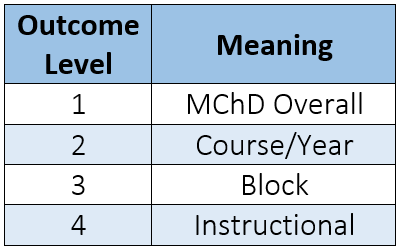
Level 2 Course Outcomes
- Phase 1 – Years 1 & 2 Learning Outcomes
- Phase 1 – Research Project Learning Outcomes
- Phase 2 – Year 3 Learning Outcomes
- Phase 2 – Year 4 Learning Outcomes
- Phase 1 & 2 – Professional Practice Learning Outcomes
Phase 1 – Years 1 & 2 Learning Outcomes
Outcome 2.1: You will develop competency in history taking and clinical examination in preparation for Phase 2.
Outcome 2.2: You will develop effective methods of knowledge and skill acquisition to meet your individual learning needs.
Outcome 2.3: You will be able to discuss the structure and functions of the Australian health care system.
Outcome 2.4: You will demonstrate knowledge of Australian Indigenous culture and history, and the impact on health.
Outcome 2.5: You will extend and integrate key principles of ethics, law and human rights regulating medical professionalism.
Outcome 2.6: You will design and complete a research project.
Phase 1 – Research Project Level 2 Learning Outcomes
Outcome 2.22: Teach students to identify research questions, and design and implement a research plan
Outcome 2.23: Foster critical analysis of the literature and, where appropriate, teach students how to explore, analyse and summarise research data sets
Outcome 2.24: Teach students to synthesise their ideas and present coherent arguments
Outcome 2.25: Encourage students to develop publication style writing skills
Outcome 2.26: Promote career development through original research
Phase 2 – Year 3 Learning Outcomes
Outcome 2.7: Demonstrate excellent communication skills that are patient centred and enable patients and carers to understand their health problems and share decision making around their health care choices; support the maintenance of a patient’s privacy and dignity and recognise the impact of their own values and experiences in their engagement with patients and carers.
Outcome 2.8: Demonstrate skills in comprehensive history taking, examination and appropriate use of investigations; establish relevant differential diagnoses and interpret results to determine a working diagnosis; distinguish between encounters in which a targeted approach is appropriate and those where a thorough and comprehensive history is essential.
Outcome 2.9: Synthesise a patient’s history and physical findings to provide a succinct summary of a patient’s main problems, and any other relevant intercurrent issues that may impact on management.
Outcome 2.10: Apply their knowledge of medical sciences and epidemiology to a patient presentation and diagnosis; critically appraise information and integrate quality and safety frameworks in clinical decision making.
Outcome 2.11: Contrast the structure and function of the health system in community and acute settings; identify and summarise the challenges of access and equity for difficult-to reach and disadvantaged populations (including Aboriginal and Torres Strait Islander, rural and remote populations) and the doctor’s role in responding to these challenges.
Phase 2 – Year 4 Learning Outcomes
Outcome 2.12: Demonstrate excellent communication skills that are patient centred and enable patients and carers to understand their health problems and share decision making around their health care choices; support the maintenance of a patient’s privacy and dignity; recognise the impact of their own values and their professional status in engaging with patients, carers and colleagues.
Outcome 2.13: Demonstrate skills in comprehensive history taking, examination and appropriate use of investigations; establish relevant differential diagnoses and interpret results to determine a working diagnosis; distinguish between encounters in which a targeted approach is appropriate and those where a thorough and comprehensive history is essential.
Outcome 2.14: Synthesise a patient’s history and physical findings to provide a succinct summary of a patient’s main problems and any other relevant inter-current issues that may impact on investigations and management; respectfully communicate this information to other members of the team involved in patient care.
Outcome 2.15: Formulate a management plan that includes appropriate drug therapy and if necessary, interventional and/or allied health management; articulate the importance of teamwork; practise effective handover of care recognising the boundaries of responsibility.
Outcome 2.16: Apply their knowledge of medical sciences and epidemiology to a patient presentation, diagnosis and management; critically appraise information and integrate quality and safety frameworks in clinical decision making.
Outcome 2.17: Contrast the structure and function of the health system in community and acute settings; evaluate the challenges of access and equity for difficult-to-reach and disadvantaged populations (including Indigenous, rural and remote populations) and identify and explain the doctor’s role in responding to these challenges.
Phase 1 & 2 – Professional Practice Level 2 Learning Outcomes
Outcome 2.18: Shows respect for the inherent dignity of every human being (with an appreciation of the diversity of human background and cultural values)
Outcome 2.19: Shows an understanding of the importance of teamwork, collegiality and the regulatory framework in the learning process and in achieving patient outcomes
Outcome 2.20: Shows an understanding of a doctor’s role in relation to patient safety, relief of suffering and disease
Outcome 2.21: Shows a commitment to compassionate professional behaviour in accord with conscience, medical ethics, law and human rights